Buying guide
What a BMS does and why it matters
The battery management system is the electronics inside every lithium pack. What it monitors, what it protects against, why it balances cells, and what its behaviour means for you day to day.
Lithium iron phosphate batteries · made in India by Trontek
Batteries
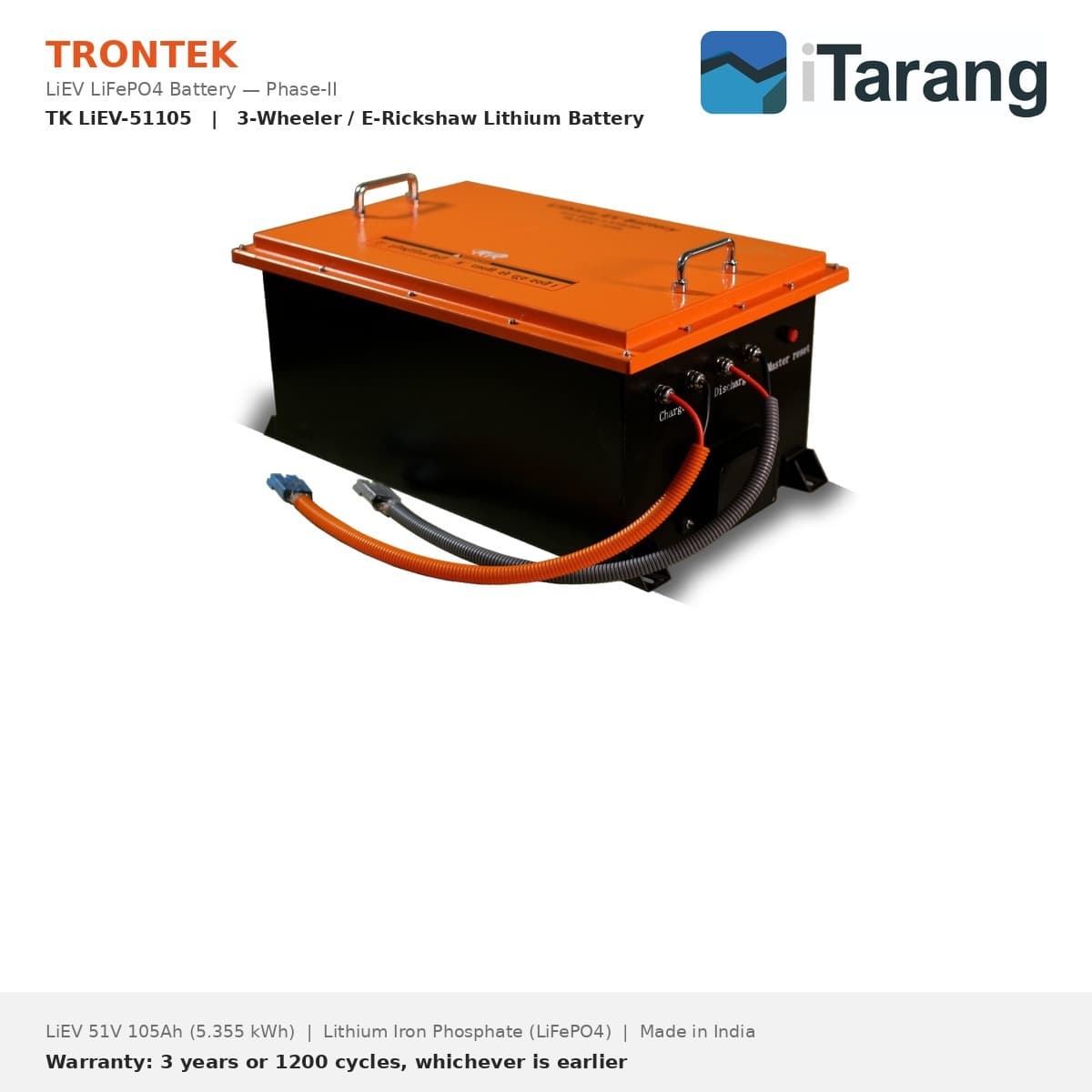
High-capacity LiFePO4 packs for e-rickshaws and e-loaders, sized in kWh for a day of duty.
The same nominal voltage as your controller — usually printed on the controller or in the vehicle manual. Most e-rickshaws run on 48 V or 60 V systems; a 51 V LiFePO4 pack replaces a 48 V system and a 61 V pack a 60 V system. Never fit a pack of a different voltage class.
Roughly the pack’s energy in watt-hours divided by your rickshaw’s consumption per kilometre — typically 55–90 Wh/km depending on load, motor and roads. A 5.4 kWh pack therefore gives very roughly 60–95 km. The EV battery calculator works it out for your vehicle.
Yes — a lithium pack needs a lithium charger matched to its charge voltage. Each battery page lists the Trontek chargers that fit it.
It is stated on each product page in Trontek’s words — for example 3 years or 1200 cycles, whichever comes first.
Buying guide
The battery management system is the electronics inside every lithium pack. What it monitors, what it protects against, why it balances cells, and what its behaviour means for you day to day.
Care & safety
Everyday habits that keep an EV or home lithium battery safe and long-lived in Indian conditions: the right charger, where and when to charge, handling summer heat and monsoon damp, and storing a battery you are not using.
Buying guide
A practical guide for e-rickshaw and 3-wheeler owners in India: how to read pack voltage, amp-hours and kWh, work out the range you need, and check a battery will actually fit and work with your vehicle.
An e-rickshaw is a working vehicle, so the number that matters is energy — kilowatt-hours — rather than ampere-hours alone. Energy divided by the vehicle’s consumption per kilometre is the honest estimate of a day’s range, and consumption varies with passenger load, terrain and motor rating far more than with the battery.
Lithium iron phosphate replaces a lead-acid bank at roughly a third of the weight and several times the cycle life, with no water topping, no acid and no terminal corrosion. Against daily deep cycling that difference compounds quickly.
A traction pack must match the controller and the charger. Confirm the system voltage, the charge voltage and the connector before ordering, and use only a charger approved for the pack.

Not sure what you need?
Size a system from your actual appliances, or talk to one of our engineers.
1 product
105 Ah